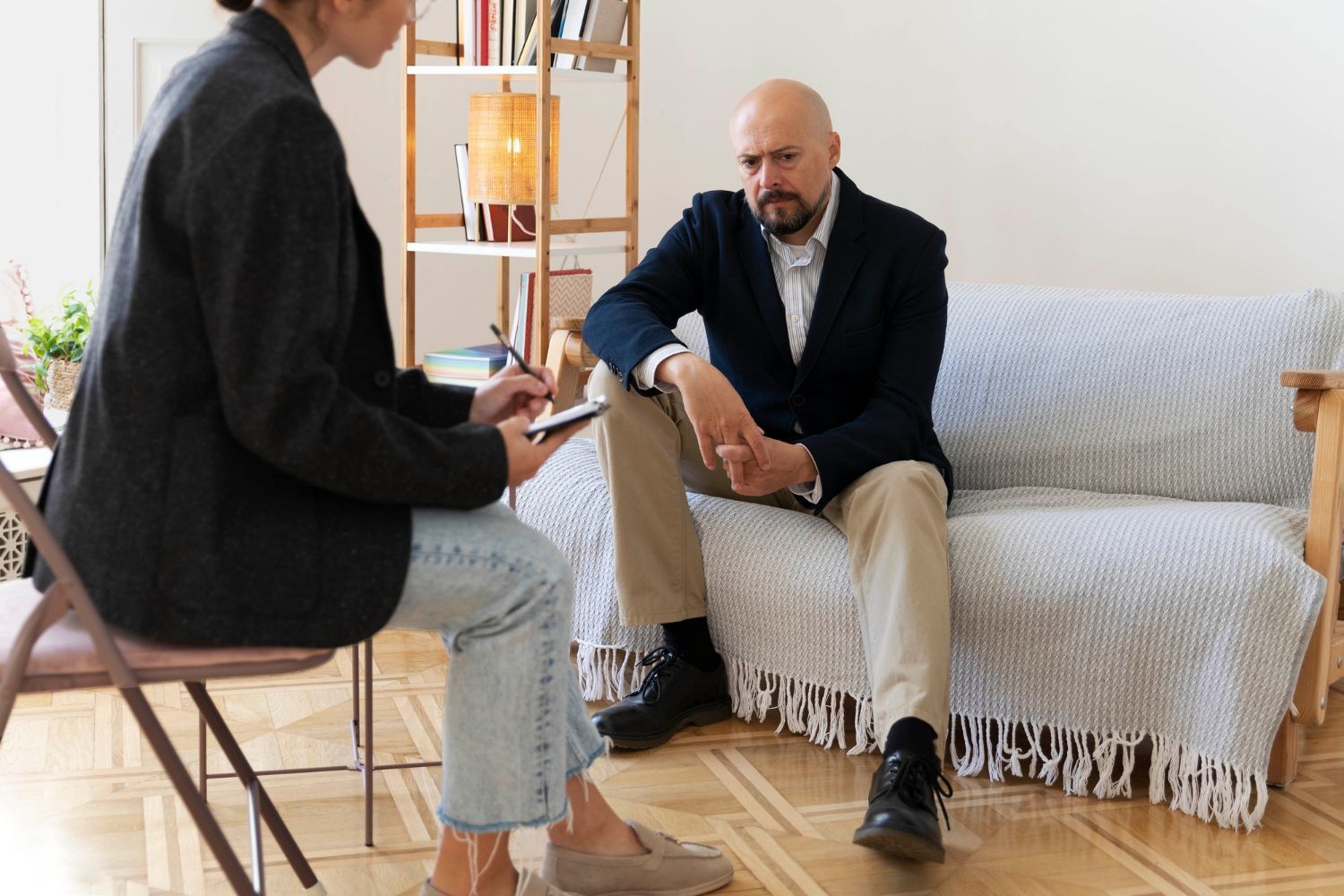
You’re Talking, But Nothing Is Getting Resolved: Why Couples Repeat the Same Conversation

Some couples don't have one big problem. They have the same small problem over and over again. It might start with something ordinary. Someone forgot to do something. A plan changed. Money was spent.
One partner felt ignored. The conversation starts, both people explain themselves, and eventually someone gets frustrated. Nothing really gets settled. Then the issue comes back.
After enough rounds, the subject almost becomes secondary. What matters is what happens every time the subject comes up.
That is an important distinction when considering couple therapy in Los Angeles. Sometimes the useful question isn't, “How do we solve this argument?” It's, “Why do we keep having this argument in almost the same way?”
You May Be Arguing About the Pattern Without Realizing It
Imagine one partner says, “You never help unless I ask.”
The other responds, “That's not true. I did it yesterday.”
The first person brings up another example.
The second person brings up one of their own.
Pretty soon, they're not discussing today's problem at all. They're building cases against each other. This can happen with almost any subject.
A disagreement about household chores can turn into a discussion about appreciation. A conversation about spending can become an argument about trust.
A complaint about cancelled plans can become a much older conversation about feeling unimportant. The original issue is still there, but now it's carrying everything that came before it.
The Sentence You Hear May Not Be the Message You Need to Answer
When people are upset, they don't always express the underlying concern directly.
“You don't care.”
“You're always criticizing me.”
“I can't say anything without starting a fight.”
Those statements can sound like accusations. But sometimes there's a more vulnerable message underneath:
“I don't feel important to you.”
“I don't feel good enough for you.”
“I don't know how to talk to you without this becoming a fight.”
If one person responds to the accusation while the other is trying to express hurt, they can talk for an hour and still miss each other.
At Viviana Suaya, we look at those emotional and behavioral patterns as part of understanding relationship concerns. Our goal isn't to decide who made the better argument. It's to understand what keeps happening between the two people.
Pay Attention to the Moment Things Go Sideways
Most couples don't start a difficult conversation already angry. There's usually a point where it changes.
- Maybe someone says, “You always do this.”
- Maybe the other person rolls their eyes.
- Maybe one partner starts explaining while the other stops listening.
- Maybe someone walks away.
That moment matters.
If you're exploring couple therapy in Los Angeles, try noticing what usually happens right before the conversation falls apart. You may find that the same trigger appears again and again, even when the subject is different.
Once you can see that moment, the argument becomes easier to understand. You're no longer looking only at the last five minutes. You're looking at the sequence.
Why Explaining More Doesn't Always Help
Feeling misunderstood can make people talk more.
They add examples. They repeat themselves. They explain what happened in greater detail. They point out exactly when their partner did something similar before.
It makes sense.
If the other person didn't understand the first time, maybe they'll understand after the fifth explanation. But something else can happen. The extra explanations can start sounding like evidence in a trial.
The person listening may stop trying to understand and start preparing a defense. Then the first person feels even more ignored. So they push harder.
That's how two people who both want to be understood can end up making understanding harder.
A Solution Can Still Leave Something Unfinished
Sometimes couples do reach an agreement. One person agrees to help more. The other agrees to communicate sooner. A schedule changes. Someone apologizes. And yet the argument returns. Why?
Because solving the practical issue doesn't always resolve what the issue meant to each person. If someone felt dismissed, completing the task may not erase that feeling. If someone felt constantly criticized, changing one behavior may not remove the expectation that they'll be criticized again.
For couple therapy in Los Angeles, this is an important distinction. A useful conversation may need to address both the problem itself and what each partner has started to associate with that problem.
You Don't Have to Agree About Everything
A relationship isn't successful because two people eventually think the same way. Partners can have different spending habits, different social needs, different ways of handling stress and different ideas about how much time they should spend together.
Some differences may never disappear. What can change is how those differences are handled. The Gottman Method, for example, places attention on recurring interaction patterns and ways couples respond to one another during conflict.
At Viviana Suaya, we recognize that relationship concerns can also exist alongside individual emotional or behavioral difficulties. Depending on the situation, support may involve couples therapy, individual therapy or both.
Try Watching the Conversation Instead of Winning It
The next time the same disagreement starts, notice the order of events.
Who brings it up?
What happens next?
When does one person become defensive?
When does the other start pushing harder?
Does someone go quiet?
How does the conversation end?
You may discover that your arguments have a predictable shape. That's valuable because a pattern is something you can examine. Being “bad at communication” is much harder to work with because it doesn't tell you what is actually happening.
When the Same Conversation Keeps Returning
If you've had the same argument ten times, having it an eleventh time with slightly better wording may not be enough. You may need to understand why the conversation keeps taking the same route.
That's one reason couple therapy in Los Angeles can be useful for couples who feel stuck in recurring conflict. The focus can move from the latest disagreement to the relationship pattern underneath it. At Viviana Suaya, we work with couples to explore those patterns and the emotional factors that may be keeping them in place.
For someone considering couple therapy in Los Angeles, the goal doesn't have to be a relationship where nobody argues. That's probably unrealistic.
A more useful goal is being able to disagree without automatically falling into the same script. The argument may still happen. But maybe, for once, it doesn't have to end the same way.